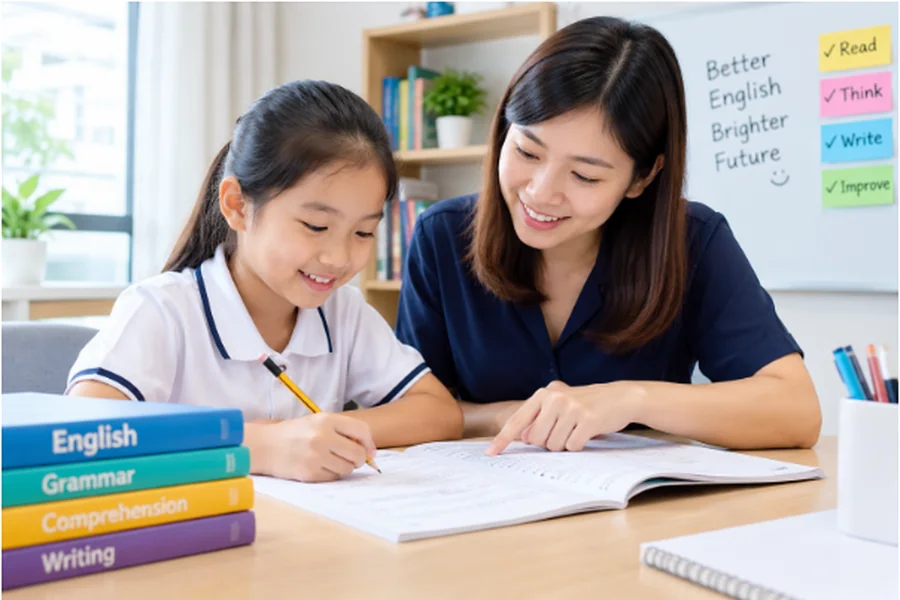
Primary 6 is an important stage for English students in Singapore. By this point, students are expected to handle more demanding reading and writing tasks while preparing for the PSLE. Composition writing is one area where a student’s ability to organise ideas, use appropriate vocabulary and develop a clear storyline becomes increasingly important.
Some students have plenty of ideas but struggle to turn them into a coherent composition. Others understand the basic structure of a story but rely on repetitive vocabulary or produce very short paragraphs. English tuition for Primary 6 can provide additional practice in these areas, particularly when lessons are structured around the student’s individual weaknesses.
Understanding What Makes a Strong Composition
A good composition involves more than correct spelling and grammar. The storyline needs to make sense, events should follow a logical sequence, and the characters should have enough detail to make the narrative understandable.
Students also need to respond to the given topic rather than writing a memorised story that only loosely relates to the question.
This is where planning becomes important. Before writing, a student should understand the situation, identify the main characters and decide what happens from the beginning to the end.
Developing Ideas from Visual Prompts
Primary school composition questions often require students to use visual prompts as part of their writing. A picture might show a particular person, object, location or event that needs to be incorporated into the story.
Students sometimes focus too heavily on describing the picture itself. A stronger approach is to use the visual information as a starting point for developing a complete narrative.
For example, a picture showing a child standing outside a shop does not determine the entire story. The student still needs to decide why the child is there, what happens next and how the situation is resolved.
Learning to Plan Before Writing
Students under time pressure often want to start writing immediately. While this feels faster, skipping planning can result in a story with disconnected events.
A short planning period allows students to establish the main sequence before committing it to paper. They might identify the setting, characters, problem, key events and resolution.
The plan does not need to contain complete sentences. A few useful notes can be enough to keep the story on track.
Improving Vocabulary Without Overcomplicating It
Vocabulary plays an important role in composition writing, but students do not need to fill every sentence with complicated words.
The more useful goal is precision. Instead of repeatedly using basic words such as “said”, “went” or “nice”, students can learn alternatives that accurately describe the situation.
Descriptive vocabulary also helps when writing about emotions, movement, settings and reactions. A character who is worried might hesitate, glance around repeatedly or speak nervously. These details communicate the emotion without repeatedly stating that the character was worried.
Strengthening Sentence Structure
Sentence variety helps a composition read more naturally.
Students who rely heavily on short sentences might produce writing that feels abrupt. On the other hand, excessively long sentences can become confusing when ideas are joined incorrectly.
Tuition can focus on helping students combine ideas appropriately, vary sentence openings and use conjunctions accurately.
Making Characters More Believable
A composition becomes easier to follow when characters have understandable motivations and reactions.
Instead of writing that a character was “very scared”, a student might describe what the character did when something unexpected happened. Physical reactions, dialogue and thoughts can provide additional detail.
This also helps students avoid writing characters who simply move from one event to another without showing any response.
Creating a Clear Story Structure
A composition needs a beginning, development and ending.
The opening establishes the setting and situation. The middle introduces the main event or problem and develops what happens next. The ending resolves the situation rather than stopping suddenly.
Students often spend too much time introducing the story and then rush through the ending because of time limitations.
Practising different story structures during Primary 6 English tuition helps students become more comfortable allocating their time across the composition.
Learning to Edit Under Time Pressure
Writing the final sentence does not necessarily mean the task is finished.
Students should develop the habit of checking their work for spelling, grammar, punctuation and missing words. They should also consider whether the story makes sense from beginning to end.
Time management matters here. If every available minute is spent writing, there might be little opportunity to review the composition.
Timed practice can help students learn how much time they need for planning, writing and checking.
Addressing Individual Writing Problems
One advantage of additional English tuition is the opportunity to focus on specific weaknesses.
Two Primary 6 students might receive the same composition topic but struggle for completely different reasons. One student might have difficulty generating ideas, while another has plenty of ideas but struggles with sentence structure.
A targeted approach allows practice to focus on the skill that needs more attention.
Feedback is also important. Simply completing composition after composition does not guarantee improvement. Students need to understand what was weak, why it affected the writing and how to approach the same problem differently next time.
Preparing Without Relying on Memorised Essays
Memorising complete compositions might appear useful because it gives students ready-made phrases and story structures. The problem is that examination prompts vary.
A memorised story might not fit the characters, situation or picture prompts given in a particular task.
Students are better served by learning transferable skills. Understanding how to develop a conflict, describe emotions, organise events and create an appropriate ending gives them more flexibility when facing an unfamiliar topic.
Useful phrases and vocabulary still have a place in preparation, but they should support original writing rather than replace it.
Balancing Tuition with Independent Practice
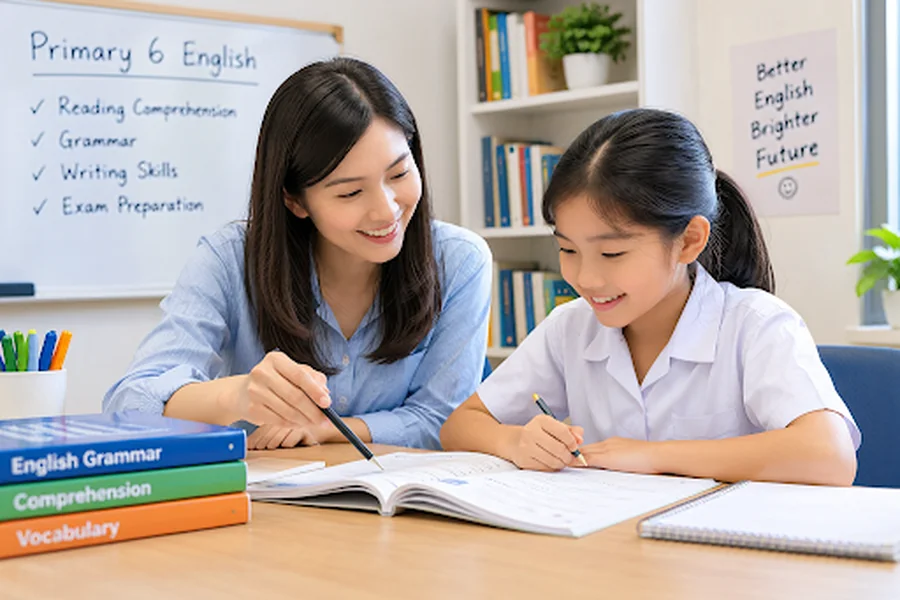
Tuition works best when students also have opportunities to write independently.
A tutor can explain techniques, identify weaknesses and provide feedback, but students need repeated practice to develop confidence. Short writing exercises can sometimes be useful alongside full compositions.
For example, a student struggling with descriptive writing might practise describing a setting or character before attempting another complete story.
Parents can also encourage reading outside tuition. Exposure to well-written children’s books gives students examples of vocabulary, dialogue, sentence structure and storytelling.
Managing Exam Pressure
Preparation is not limited to language skills. Students also need to become familiar with working within an examination setting.
Timed practice can help students understand how quickly they need to plan and write. It also provides an opportunity to identify habits that cause unnecessary delays.
The goal is to make the process familiar enough that students can focus on the task rather than feeling overwhelmed by the time limit.
A calm and consistent approach to preparation is generally more useful than leaving composition practice until the final weeks before the examination.
Final Thoughts
Composition writing requires students to bring several English skills together. Vocabulary, grammar, sentence structure, planning and storytelling all contribute to the final piece of writing.
For Primary 6 students preparing for the PSLE, focused English tuition can provide additional practice and feedback when particular areas need attention. The most useful preparation is built around developing adaptable writing skills rather than memorising complete stories.