Some skills matter more than words. We collect inspiring quotes, pin them to our walls, and share them online, and there's real value in a line that lifts us up. But there's a different kind of value in knowing exactly what to do when someone stops breathing. If you've ever wanted a practical skill that could genuinely change a life, earning your certification through Red Cross First Aid training might be the most meaningful thing you do all year. It's one of those rare skills that turns good intentions into real action.
Motivation is wonderful. Readiness is better. Let's talk about why.
Why Is First Aid the Ultimate Life Skill?
Think about the skills we admire most. Cooking a great meal. Fixing a leaky tap. Speaking a second language. All useful, all worth having.
Now picture a skill that doesn't just improve a day, it can save a life. First aid sits in a category of its own because the stakes are so high and the window to act is so small.
Here's the honest part. You can live your whole life and never need it. Or you could need it tomorrow, at a family dinner, in a grocery store, or on a quiet street in Brampton. The problem is you never get to choose which.
That's exactly why learning it ahead of time matters. Emergencies don't send a calendar invite.
What Happens in Those First Few Minutes?
When someone's heart stops, time becomes everything. In Canada, roughly 60,000 cardiac arrests happen outside hospitals every year, and only about 1 in 10 people survive.
That statistic feels heavy, but there's hope inside it. Immediate CPR combined with an AED can double someone's chance of survival. Every minute that passes without help, though, lowers the odds by seven to ten percent.
Paramedics are skilled and fast, but they can't teleport. The minutes before they arrive belong to whoever is standing nearby. A trained bystander isn't a backup plan. In those moments, they're the main event.
Isn't CPR Complicated and Scary?
This is the belief that stops so many people, and it's mostly a myth.
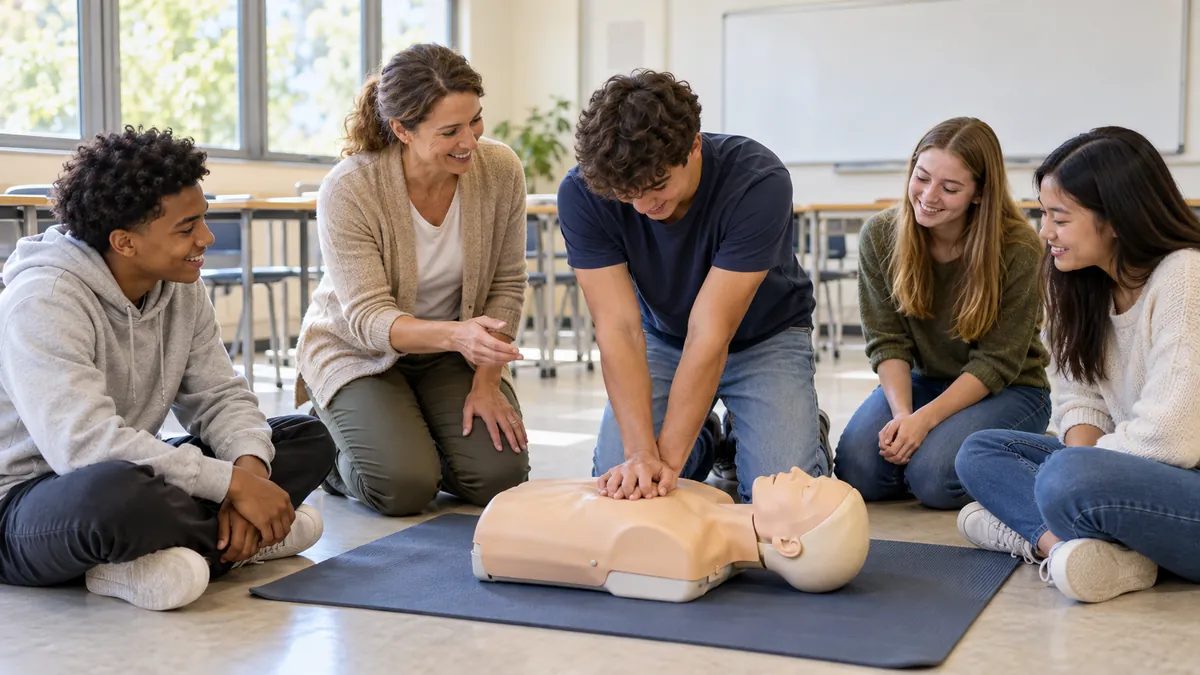
For someone with no training, hands-only CPR is both simple and effective. You push hard and fast in the centre of the chest, around 100 to 120 compressions a minute, letting the chest rise fully between each push. That's it. No mouth-to-mouth required for the untrained.
The deeper training, which teaches the 30 compressions to 2 breaths rhythm and how to handle children and infants, builds on that same foundation. It's learnable in an afternoon. You don't need medical knowledge. You need willingness and a little practice.
The fear isn't really about difficulty. It's about not knowing. Training replaces that fear with calm, because your hands know the steps before your mind has time to panic.
What Core Skills Should Everyone Have?
If you're wondering what a solid first aid foundation looks like, here are the essentials worth carrying through life:
- Hands-only CPR for a collapsed adult who isn't breathing normally
- How to use an AED, those lifesaving devices now found in gyms, offices, and public buildings
- Choking response for adults, children, and infants
- Controlling serious bleeding until help arrives
- Recognizing the signs of a heart attack, stroke, or severe allergic reaction
Each of these is a tool. You hope you never open the box, but you'll be deeply grateful it's there if you do.
How Approachable Is the Training, Really?
Here's where modern first aid training shines. You no longer have to block off two full days in a classroom.
Many courses now use blended learning. You complete the theory online, at your own pace, whenever it suits you. Then you attend one short in-person session to practise the physical skills with a qualified instructor. The online part fits around work and family. The hands-on part is quick, focused, and surprisingly enjoyable.
This matters in a place like Brampton, where life moves fast. Between manufacturing shifts, school runs, and everything else Brampton packs into a week, flexibility isn't a luxury. It's the difference between signing up and putting it off forever.
Who Should Learn First Aid?
The short answer? Almost everyone.
Parents and grandparents benefit because children face choking and water risks that demand quick, confident action. Workers in Brampton's logistics, warehouse, and manufacturing sector gain skills that protect their coworkers on the floor. Coaches, teachers, and volunteers become safer for every person in their care.
Even if you live alone and work from home, you move through a community full of people. The stranger who collapses at the bus stop doesn't care about your job title. They care that someone nearby knows what to do.
First aid is one of the few skills that makes you more valuable to literally everyone around you.
Does One Trained Person Actually Matter?
Picture a room of twenty people when someone suddenly collapses. If nineteen of them don't know CPR and one does, that single person changes everything. They kneel down, start compressions, and call for an AED while others freeze.
That's the quiet power of being the one who's ready. You don't need the whole crowd trained. You need to be the person who steps forward.
And once you've learned, you often become a quiet advocate. You notice where the AEDs are. You remind a friend their certificate is expiring. You spread readiness without even trying. Finding a course through Coast2Coast First Aid near you is a simple way to become that person.
What's the Takeaway?
We love a good quote because it captures something true in a few words. But a quote can only inspire. A skill can act.
Learning first aid is how you turn "I wish I could help" into "I know what to do." It's practical, it's learnable, and it belongs to you for life once you've got it, with a quick refresher every three years to keep it sharp.
So here's a thought worth more than any pinned-up saying: the best time to learn how to save a life was years ago. The second-best time is now.
What Holds People Back, and Why Those Reasons Don't Hold Up?
Let's be honest about the excuses, because they're the real reason most people never learn.
"I don't have time." Blended learning solves this. The theory fits around your life, and the in-person piece is short. You spend more time scrolling your phone in a single week than a refresher takes.
"I'd probably panic anyway." The opposite is true. Panic comes from not knowing. Training replaces uncertainty with a clear set of steps, so your hands move even when your heart is pounding.
"Someone else will handle it." Maybe. But in most real emergencies, people freeze and look around for a leader. Being trained means you become that leader instead of another face in the crowd.
"I'm worried I'll do it wrong and make things worse." For someone in cardiac arrest, doing nothing is the worst outcome. Hands-only CPR, done imperfectly, still vastly improves their odds. Ontario's Good Samaritan Act also offers protection to those who step in to help in good faith, so the fear of legal trouble shouldn't hold anyone back from acting.
"I'll learn it someday when I have more time." Someday has a way of never arriving. The best moment to prepare is before you need to, not in the middle of a crisis when it's already too late.
Strip away the excuses, and what's left is a simple, achievable skill with enormous upside.
How Does One Skill Ripple Outward?
Here's something worth reflecting on. When you learn first aid, the benefit doesn't stop with you.
You become the person who notices the AED on the wall. The one who reminds a coworker their certificate is lapsing. The parent who teaches their kids what to do if someone gets hurt. Your single decision to train quietly raises the readiness of everyone around you.
Communities don't become safer through grand gestures. They become safer one prepared person at a time. A workplace with a trained employee, a family with a trained parent, a sports team with a trained coach, these are the threads that hold a community's safety net together.
So when you learn first aid, you're not just investing in yourself. You're adding one more capable person to a town that's stronger for having you ready. That's a quiet kind of leadership anyone can choose.
If you're looking for first aid and CPR training near Kennedy Road South near Queen Street, the Bramalea City Centre area, or surrounding areas, you may reach out to Coast2Coast First Aid & Aquatics in that area.
Frequently Asked Questions
Q: Do I need any medical background to learn first aid or CPR?
A: Not at all. First aid courses are designed for complete beginners. You'll learn everything step by step, and the hands-only CPR technique in particular is simple enough for anyone to perform. Willingness matters far more than any prior knowledge.
Q: How long does it take to get certified?
A: With blended learning, you finish the theory online at your own pace, then attend one short in-person skills session. Many people complete the whole process within a few days, fitting the online portion around their existing schedule.
Q: What's the difference between hands-only CPR and full CPR?
A: Hands-only CPR is chest compressions alone, recommended for untrained bystanders. Full CPR adds rescue breaths in a 30-to-2 ratio and covers techniques for children and infants. Trained rescuers learn both, while anyone can safely perform hands-only CPR in an emergency.
Q: How often should I renew my certification?
A: Standard first aid and CPR certifications are typically valid for three years. Renewing on time keeps your skills current, since hands-on abilities naturally fade without regular practice.
Q: Is first aid training useful if I don't have kids or a high-risk job?
A: Absolutely. Emergencies happen anywhere, to anyone. Whether it's a stranger at a store or a neighbour on the street, being trained means you can help wherever you are. It's a skill that benefits your entire community, not just your household.