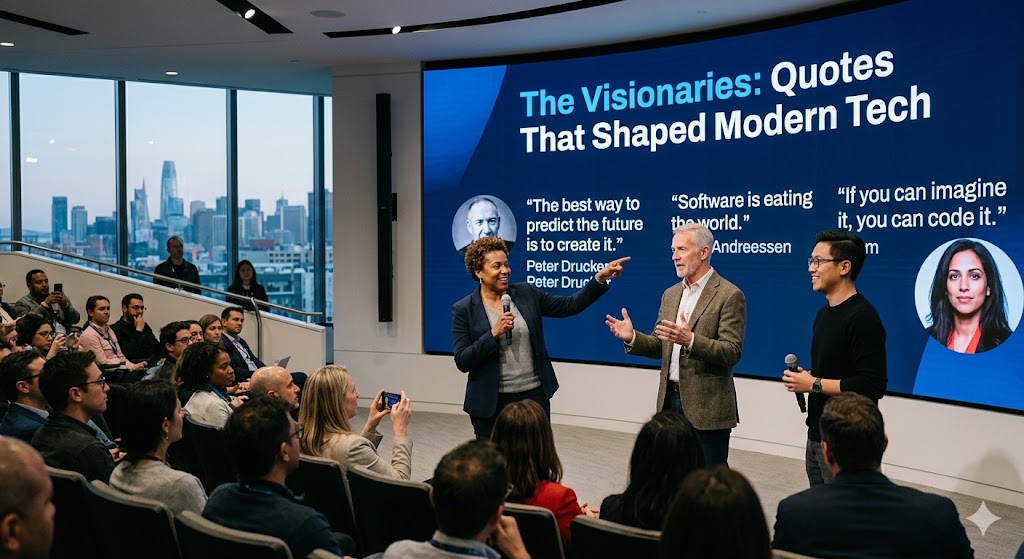
Technology is often perceived as a consistent progression of silicon, code and hardware. However, for every giant technological breakthrough, there was a philosophy, a human vision that saw what was not and said “why not?”
We know at Quotenestify words can create worlds.
In the tech world, a “just in time” quote is not only a PR soundbite, it’s a northstar for thousands of engineers, designers and developers. Analyzing the words used by early adopters of this industry can reveal the blueprints for the digital world that we live in today.
The following are 4 visionary quotes from today that not only forecasted the future of technology, but actually helped to create it.
- Ada Lovelace: Seeing Beyond the Calculator
The Analytical Engine is able to ‘weave’ algebraic patterns like the Jacquard loom weaves flowers and leaves.
— Ada Lovelace (1843)
The Context:
Charles Babbage constructed a large mechanical calculating machine in the middle of the 19th century, called the “Analytical Engine. Babbage was by himself at the time in envisioning a machine that would perform logic. Most scientists of the day, even Babbage, saw the machine as a number-crunching device, one that could automate the tedious numbers work. Mathematician and writer Ada Lovelace saw something else.
How It Shaped Tech:
If a machine can perform operations on numbers, and if numbers can stand for other objects (such as letters, musical notes or logic), then a machine can compute anything, thought Lovelace. Her analogy with the Jacquard loom (which used punch cards to create intricate designs in textiles) was the first general statement of “general purpose computing.
Indeed, she kind of guessed software. Her words serve as the philosophical foundations of computers; although it will take more than 100 years for the physical hardware to come to fruition.
How to Make Things Disappear.Mark Weiser: The Invisible Future.
The most powerful technologies are the ones that fade away. They become a part of daily life, so much so that they’re no longer noticeable.
— Mark Weiser (1991)
The Context:
Personal computers were bulky, dull and occupied your whole attention in 1991. It was necessary to sit at a desk and be “active with the computer. Mark Weiser, an Xerox PARC chief scientist, penned a seminal paper titled The Computer for the 21st Century, saying this was not the way to go. He is the creator of the term Ubiquitous Computing.
How It Shaped Tech:
Weiser envisioned a world in which screens and sensors would permeate everything, speaking in the background. His vision became our reality today. Smartwatches monitor our health, smart thermostats learn from our behavior, and smart assistants control our homes. The most successful modern technologies, such as smartphones and the Internet of Things (IoT), are the ones that we don’t even realize we use. Weiser’s words changed the game from one of making machines that need to be paid attention to, to one of environments that will serve us.
- Steve Jobs: The Crossing Over of Art and Science
Technology will not solve everything; it’s technology and the liberal arts, it’s technology and the humanities that will give us the results that make our hearts sing.
— Steve Jobs (2011)
The Context:
The quote was given at the end of the iPad 2 launch by Steve Jobs at one of his last public appearances. Its rivals were very much preoccupied with specifications; processor speed, gigabytes of RAM and screen resolution were all big issues. Jobs was out to make a point about what was so different about Apple’s products to the consumer.
How It Shaped Tech:
This quote represents the contemporary approach to User Experience (UX) and User Interface (UI) design. Jobs noted that a product’s worth did not lie in its raw power, but in how it made the user feel, and how it fits in their human experience. This philosophy had forced the entire tech industry to turn. It is why the focus of today’s software is on empathy, accessibility and great typography as much as backend efficiency.
There is the next paradigm shift that will happen in the coming year thanks to Jensen Huang.
While “software is eating the world,” AI is going to eat software.
— Jensen Huang (2017)
The Context:
The late venture capitalist Marc Andreessen once famously said that “software is eating the world,” meaning that all companies are going to be software companies. Six years later, NVIDIA CEO Jensen Huang updated this famous proverb. In the early days of AI, when industrial applications were relatively scarce and consumer use of the technology was far from commonplace, Huang’s sense of the tectonic plates moving was clear.
How It Shaped Tech:
Huang knew that the time of explicit, line-by-line programs for computers was coming to a close. Rather, we were about to enter a time where huge amounts of data would be used to train neural networks to create their own rules. In the 2020s, generative AI has changed the way code is written, designs are created, and work is done. NVIDIA wagered everything on it — designing the very GPUs that are driving the global AI revolution. Huang’s words marked the era of the “Information Age” turning into the “Intelligence Age.
The Power of the Tech Quote.
The world of technology is changing at a rapid pace and new ideas, frameworks, devices and languages are becoming obsolete within a few years. But the tenets of their driving philosophies remain. It may be the humanities, or it may be Lovelace dreaming of a programmable loom or Jobs championing the humanities, but the most powerful tool in technology isn’t a microchip. It’s a vision, reduced to a few flawless words, which will inspire a generation to build the future.