Introduction
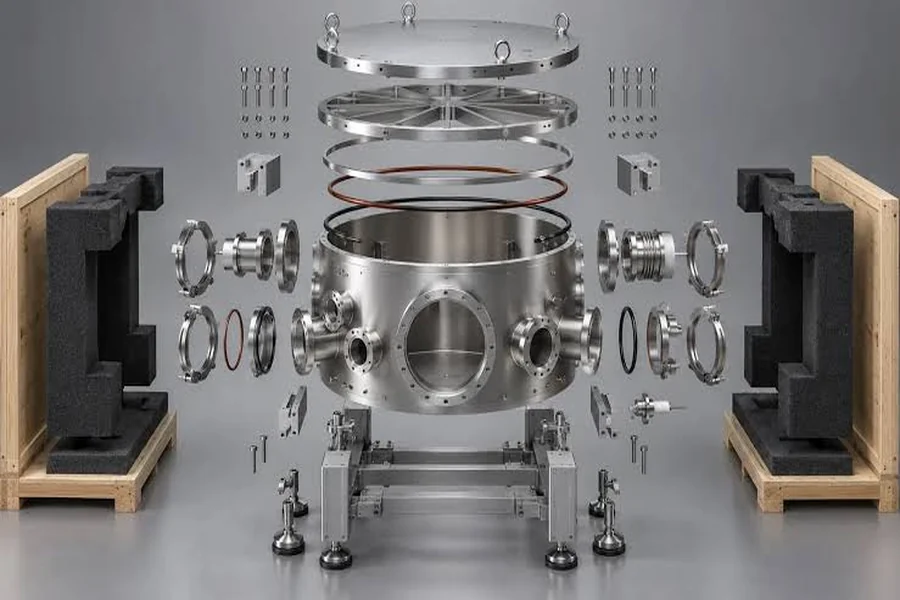
High-vacuum (HV) and ultra-high-vacuum (UHV) chamber assemblies in front-end wafer tools should have the leak rate less than 1×10⁻⁹ mbar·L/s. However, in real manufacturing, engineering and procurement departments deal with micro-leaks, poor corrosion resistance, and deflection during bakeout cycles.
All these issues arise because of improper alloy selection, lack of control over micro-porosity during DFM design stage, and bad trade-off between outgassing and thermal conductivity under plasma etching processes. This article compares aluminum 6061-T6 and 316L alloys regarding outgassing, stiffness under vacuum differential pressure, tolerances and lifecycle costs.
Why Does Vacuum Outgassing Rate Dictate Semiconductor Chamber Material Selection?
Outgassing, rather than wall thickness, determines the ceiling for the pump down rate, and this means that semiconductor vacuum chamber material selection begins where trapped gases lie.
Bulk Hydrogen Versus Oxide Moisture
For vacuum outgassing rate CNC materials selection, 316L slowly releases hydrogen while 6061-T6 quickly desorbs moisture contained in porous Al2O3 in a matter of hours; 6061 must be baked at about 150°C, 316L must be baked between 250°C and 450°C.
Texture, Electropolishing and Acceptance
Milled walls with surface roughness up to 0.4 μm provide greater effective surface than electropolished walls with surface roughness up to 0.2 μm. These precision CNC manufacturing insights, together with ASTM E595-15(2021) limits of TML ≤ 0.10% and CVCM ≤ 0.01%, enable quantifying finishing.
Data source and benchmark: ASTM E595-15(2021), Standard Test Method for Total Mass Loss and Collected Volatile Condensable Materials from Outgassing in a Vacuum Environment (CVCM ≤ 0.01%, TML ≤ 0.10%).
How Do Machining Stresses in Aluminum 6061-T6 Compare to 316L Stainless Steel?
Distortion occurs in seal faces due to stress generated from bulk machining process, which is why vacuum chamber DFM optimization takes care of leaks at an earlier stage.
l Pre-Stretched Plate Versus Second Annealing: Aluminum 6061 vacuum machining requires 6061-T651 pre-stretched plate with cryogenically stabilized stress balance; second annealing is required for 316L stainless steel vacuum parts since flange warps otherwise.
l Thermal Growth, Tool Deflection and Thin Walls: With 23×10⁻⁶/K for 6061 compared to 16×10⁻⁶/K for 316L, five-axis finishing will require the inclusion of thermal growth in tool deflection correction. Thin walls less than 3.0 mm thickness at 101.3 kPa require rib roughing prior to stress relief.
Data source and benchmark: ASME B46.1-2019 surface texture standard (Ra, Rz parameters) and Zeiss CMM official calibration report (measurement accuracy of 0.0009 mm and MPEE volumetric indication error).
When Should Engineers Specify 316L Over Aluminum 6061 in Etch and Deposition Tools?
Aluminum 6061 vs 316L vacuum chamber decisions in etch tools is based on chemical considerations, not cost; every custom vacuum chamber components manufacturer documents both.
Halogen Plasma Corrosion and Coating Routes
Plasma of Cl2, BCl3 and NF3 corrodes aluminum, making it volatile chlorides, while 316L restores its Cr2O3 layer. Type III anodization and electroless nickel flake off when HRC hardness exceeds 52, so CNC machining for semiconductor components sourcing should demand coating porosity data.
CF Knife-Edge Integrity With OFHC Gaskets
Sealing ConFlat knife edge is possible due to deformation of an OFHC copper gasket, and 1.40 ± 0.05 mm tip can endure cycling from -5°C to 450°C; therefore, only 316L or 316LN can be used here. Design engineers who choose materials for CF knife-edge compatibility with OFHC gaskets need to balance heat conductivity and chemical resistance in thermo-mechanical stability of aggressive plasma reactions and optical transfer chambers; this is explained in detail in this technical monograph on semiconductor vacuum chamber CNC machining.
What DFM Tolerances Prevent Atmospheric Deflection and Flange Sealing Failures?
Flange joint failures tend to be geometric, not metallurgical, and the advanced manufacturing education guides from OEMs agree on three principles.
1.Dovetail Groove and Knife-Edge Geometry: The fluorocarbon O-ring dovetail groove must maintain its fill ratio, whereas a CF knife edge has to have 1.40 ± 0.05 mm tip height and an unvarying angle. Proper corner radius selection early on is part of vacuum chamber DFM optimization, not using only a custom cutting groove.
2. Flatness, Tolerance Classes and Vented Holes: Below 101.3 kPa pressure, a 500 mm door dimension needs ≤ 0.012 mm flatness, with ISO 2768-1/2 fine (f/H) classes elsewhere. The vented screws eliminate the virtual leaks and increase R&D efficiency for technical teams.
Data source & benchmark: ISO 2768-1/2 fine (f/H) linear and geometrical tolerance inspection standards, along with the Go/No-Go gauge full-inspection technique.
How Can Hardware Teams Reduce Vacuum Chamber CNC Machining Costs by 30%?
Vacuum chamber CNC machining cost is determined within the CAD file, not the factory shop floor.
Aspect Ratio and Corner Radii
High aspect ratio tooling is required in deep and narrow features that add up to extended cycle times. Limiting the aspect ratio and ensuring uniform internal corner radii of 4mm or more allows for a standard set of tooling which reduces roughing cycles by 25% to 30%.
Monolithic, EBW and Batch Outsourcing
Monolithic billet machining eliminates welding but requires stock removal whereas EBW saves 85% stock compared to additional fixtures. The semiconductor CNC machining quote including different tolerance grades and organized high-vacuum components outsourcing makes the price similar to prototype and low volume.
Which Quality Verification Protocols Ensure Zero-Pore Integrity for UHV Operation?
Precision CNC manufacturing insights reveal that it is the location of the leak, not its size, which causes rework, therefore, a qualified custom CNC machining service performs verification in three steps.
Helium Leak Detection and Ultrasonic NDT
Helium Sniffer detects discrete leaks, whereas Accumulation method tests integrate the chamber up to 1×10⁻¹⁰ mbar•L/s. Afterwards, Ultrasonic Testing of the forging confirms the absence of sand holes and micro-shrinkage.
Geometry, Cleaning and Cleanroom Packaging
CMM measuring ensures proper tolerances, Advanced 5-axis manufacturing setups couple UT testing with CMM inspection data ensuring that density and geometry are confirmed before ultrasonic degreasing. At this point, a precision semiconductor CNC machining service delivers chambers in double layered vacuum packages produced in an ISO 5 (Class 100) cleanroom.
Conclusion
Choosing between aluminum 6061 and 316L trades off outgassing rate, corrosive media, vacuum-load deflection and machining economics. Aluminum 6061-T6 wins in wafer transfer chambers and heat-dissipation optical modules, while 316L stays irreplaceable in aggressive plasma etch chambers and UHV bake-out above 200°C. Strict DFM rules lift helium first-pass yield and clear the path to volume production.
FAQs
Q1: What causes virtual leaks in CNC-machined vacuum chambers?
A1: Virtual leaks happen where there is gas trapped within blind tapped holes, micro-porosities or overlapped interfaces between metals that gradually desorb into the volume of the vacuum and act like actual leakage through the walls. The use of vented fasteners and seam openings eliminates them.
Q2: Why is Aluminum 6061-T6 preferred over 7075 for vacuum applications?
A2: 6061 aluminum has better weldability, stress resistance, and stable passivation compared to 7075 aluminum whose zinc content can lead to vapor pressure instabilities during vacuum bake-out process and wafer contamination. People should go for 6061-T6 in vacuum chamber environments.
Q3: Can surface roughness directly influence the pump-down time of high-vacuum systems?
A3: Yes. Surface finish increases the effective surface area for moisture and hydrocarbon adsorption. Finishing the metal through milling and electropolishing to Ra ≤ 0.4 µm decreases outgassing and reduces pump-down time by 40%.
Q4: Which sealing interface is ideal for UHV bake-out temperatures above 200°C?
A4: The ConFlat flanges need to have OFHC copper gaskets and 316L knife-edges beyond 200°C as fluorocarbon O-rings are prone to permeation and lack of elasticity recovery. Re-torquing after each bake out process increases the gasket lifetime. Elastomers cannot withstand such cycles.
Q5: What certifications ensure quality control in semiconductor vacuum component manufacturing?
A5: ISO 9001 & AS9100D provide the dimensional certification via CMM inspection, while ISO 14001 controls the chemicals in ultrasonic degreasing, pickling and clean room vacuum packaging for an audit trail up to shipping. Buyers can get traceability to delivery.
Author Bio
This article was authored by the research and development engineers of the company, and this article is written by Gloria. LS Manufacturing is a company that offers solutions in terms of vacuum chamber materials, tolerance and inspection under ISO 9001, ISO 14001, IATF 16949 & AS9100D certifications. Prototyping assistance is provided through our CNC machining services channel which is certified custom. Contact us for a free design for manufacturability review on your vacuum chamber drawings.